

Create Yours

Top 180 Robert M. Sapolsky Quotes (2026 Update)
Page 2 of 4

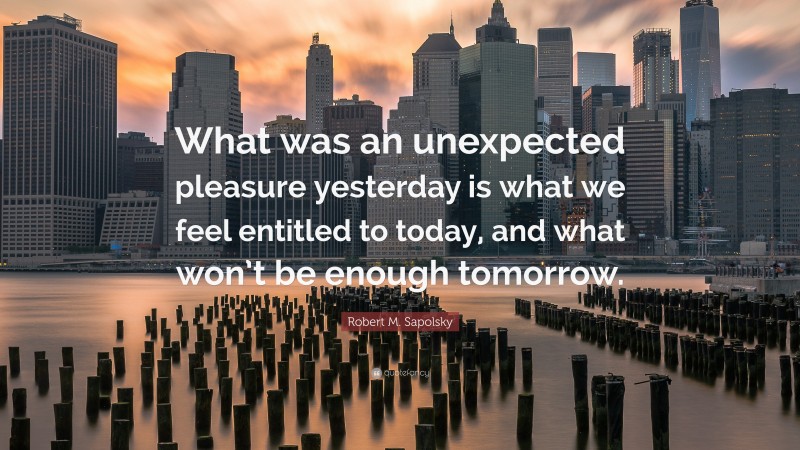
Robert M. Sapolsky Quote: “What was an unexpected pleasure yesterday is what we feel entitled to today, and what won’t be enough tomorrow.”
Robert M. Sapolsky Quote: “And their brains? Decreased total brain size, gray matter, white matter, frontal cortical metabolism, connectivity between regions, sizes of individual brain regions. Except for the amygdala. Which is enlarged. That pretty much says it all.”
Robert M. Sapolsky Quote: “Logically, when the amygdala wants to mobilize a behavior – say, fleeing – it talks to the frontal cortex, seeking its executive approval. But if sufficiently aroused, the amygdala talks directly to subcortical, reflexive motor pathways. Again, there’s a trade-off – increased speed by by-passing the cortex, but decreased accuracy. Thus the input shortcut may prompt you to see the cell phone as a gun. And the output shortcut may prompt you to pull a trigger before you consciously mean to.”
Robert M. Sapolsky Quote: “Some Poor grad student pressing on the flanks of a hamster and out comes a doctorate on the other side.”
Robert M. Sapolsky Quote: “We’re getting along so well; I trust you so much for this one second that I’m going to let you yank on me.”
Robert M. Sapolsky Quote: “In another study subjects waited an unknown length of time to receive a shock.12 This lack of predictability and control was so aversive that many chose to receive a stronger shock immediately. And.”
Robert M. Sapolsky Quote: “I was once at a conference of neuroscientists and all-star Buddhist monk meditators, the former studying what the brains of the latter did during meditation. One scientist asked one of the monks whether he ever stops meditating because his knees hurt from all that cross-leggedness. He answered, “Sometimes I’ll stop sooner than I planned, but not because it hurts; it’s not something I notice. It’s as an act of kindness to my knees.”
Robert M. Sapolsky Quote: “Depression is not generalized pessimism, but pessimism specific to the effects of one’s own skilled action.”
Robert M. Sapolsky Quote: “It is never really the case that stress makes you sick, or even increases your risk of being sick. Stress increases your risk of getting diseases that make you sick, or if you have such a disease, stress increases the risk of your defenses being overwhelmed by the disease.”
Robert M. Sapolsky Quote: “A chicken is an egg’s way of making another egg.”
Robert M. Sapolsky Quote: “Priming people to think of God as punitive decreases cheating; thinking of God as forgiving increases it. The researchers then studied subjects from sixty-seven countries, considering the prevalence in each of belief in the existence of a heaven and hell. The greater the skew toward belief in hell, rather than heaven, the lower the national crime rate. When it comes to Eternity, sticks apparently work better than carrots.”
Robert M. Sapolsky Quote: “Things that seem morally obvious and intuitive now weren’t necessarily so in the past; many started with nonconforming reasoning.”
Robert M. Sapolsky Quote: “This leads to a thoroughly fascinating finding – social conservatives tend toward lower thresholds for disgust than liberals.”
Robert M. Sapolsky Quote: “Thus there’s dopaminergic activation during schadenfreude – gloating over an envied person’s fall from grace.”
Robert M. Sapolsky Quote: “In general, our morally tinged cultural institutions – religion, nationalism, ethnic pride, team spirit – bias us toward our best behaviors when we are single shepherds facing a potential tragedy of the commons. They make us less selfish in Me versus Us situations. But they send us hurtling toward our worst behaviors when confronting Thems and their different moralities.”
Robert M. Sapolsky Quote: “I can’t really imagine how to live your life as if there is no free will. It may never be possible to view ourselves as the sum of our biology. Perhaps we’ll have to settle for making sure our homuncular myths are benign, and save the heavy lifting of truly thinking rationally for where it matters – when we judge others harshly.”
Robert M. Sapolsky Quote: “If you have to boil this book down to a single phrase, it would be “it’s complicated.”
Robert M. Sapolsky Quote: “Dogs attempt to deceive one another, with marginal success – when a dog is terrified, fear pheromones emanate from his anal scent glands, and it’s not great if the guy you’re facing off against knows you’re scared. A dog can’t consciously choose to be deceptive by not synthesizing and secreting those pheromones. But he can try to squelch their dissemination by putting a lid on those glands, by putting his tail between his legs – “I’m not scared, no siree,” squeaked Sparky.”
Robert M. Sapolsky Quote: “Someone does something lousy and selfish to you in a game, and the extent of insular and amygdaloid activation predicts how much outrage you feel and how much revenge you take.”
Robert M. Sapolsky Quote: “The opposite of love is not hate; its opposite is indifference.” The biologies of strong love and strong hate are similar in many ways, as we’ll see.”
Robert M. Sapolsky Quote: “One study showed kids, ages five to thirteen, pairs of faces of candidates from obscure elections and asked them whom they’d prefer as captain on a hypothetical boat trip. And kids picked the winner 71 percent of the time.31.”
Robert M. Sapolsky Quote: “Your heart does roughly the same thing whether you are in a murderous rage or having an orgasm. Again, the opposite of love is not hate, it’s indifference.”
Robert M. Sapolsky Quote: “With chronic stress the nucleus accumbens is depleted of dopamine, biasing rats toward social subordination and biasing humans toward depression.”
Robert M. Sapolsky Quote: “The group is more arrogant, hypocritical, self-centered and more ruthless in the pursuit of its ends than the individual.”
Robert M. Sapolsky Quote: “In a reductionist view, understanding something complex requires breaking it down into its components; understand those parts, add them together, and you’ll understand the big picture. And in this reductionist world, to understand cells, organs, bodies, and behavior, the best constituent part to study is genes.”
Robert M. Sapolsky Quote: “Testosterone makes us more willing to do what it takes to attain and maintain status. And the key point is what it takes. Engineer social circumstances right, and boosting testosterone levels during a challenge would make people compete like crazy to do the most acts of random kindness. In our world riddled with male violence, the problem isn’t that testosterone can increase levels of aggression. The problem is the frequency with which we reward aggression.”
Robert M. Sapolsky Quote: “Our nights are filled with worries about a different class of diseases; we are now living well enough and long enough to slowly fall apart.”
Robert M. Sapolsky Quote: “Like so many other animals, we have an often-frantic need to conform, belong, and obey. Such conformity can be markedly maladaptive, as we forgo better solutions in the name of the foolishness of the crowd.”
Robert M. Sapolsky Quote: “Look at systematic patterns of cultural variation as they pertain to the best and worst of our behaviors. Explore how different types of brains produce different culture and different types of culture produce different brains. In other words, how culture and biology coevolve.3 See the role of ecology in shaping culture.”
Robert M. Sapolsky Quote: “What happens when children observe domestic violence, warfare, a gang murder, a school massacre? For weeks afterward there is impaired concentration and impulse control. Witnessing gun violence doubles a child’s likelihood of serious violence within the succeeding two years. And adulthood brings the usual increased risks of depression, anxiety, and aggression. Consistent with that, violent criminals are more likely than nonviolent ones to have witnessed violence as kids.”
Robert M. Sapolsky Quote: “So dopamine is more about anticipation of reward than about reward itself.”
Robert M. Sapolsky Quote: “This level is egoistic in that rules and their application come from within and reflect conscience, where a transgression exacts the ultimate cost – having to live with yourself afterward. It recognizes that being good and being law-abiding aren’t synonymous.”
Robert M. Sapolsky Quote: “Thus, for our purposes, genes aren’t about inevitability. Instead they’re about context-dependent tendencies, propensities, potentials, and vulnerabilities. All embedded in the fabric of the other factors, biological and otherwise, that fill these pages.”
Robert M. Sapolsky Quote: “These differing emphases explain a lot – for example, the classical liberal view is that everyone has equal rights to happiness; rightists instead discount fairness in favor of expedient authority, generating the classical conservative view that some socioeconomic inequality is a tolerable price for things running smoothly.”
Robert M. Sapolsky Quote: “In other cases the challenge is to appreciate how, though human physiology resembles that of other species, we use the physiology in novel ways.”
Robert M. Sapolsky Quote: “Depression’s defining symptom is anhedonia, the inability to feel, anticipate, or pursue pleasure. Chronic stress depletes the mesolimbic system of dopamine, generating anhedonia. The link between childhood adversity and adult depression involves both organizational effects on the developing mesolimbic system and elevated adult glucocorticoid levels, which can deplete dopamine.”
Robert M. Sapolsky Quote: “It was the relative, not absolute, size of the surprise that mattered over a tenfold range of reward.”
Robert M. Sapolsky Quote: “Thus transcription factors regulate genes. What regulates transcription factors? The answer devastates the concept of genetic determinism: the environment.”
Robert M. Sapolsky Quote: “What Wilkinson and others have shown is that poverty is not only a predictor of poor health but, independent of absolute income, so is poverty amid plenty – the more income inequality there is in a society, the worse the health and mortality rates.”
Robert M. Sapolsky Quote: “For the vast majority of beasts on this planet, stress is about a short-term crisis, after which it’s either over with or you’re over with. When we sit around and worry about stressful things, we turn on the same physiological responses – but they are potentially a disaster when provoked chronically.”
Robert M. Sapolsky Quote: “In contrast, conservatives heavily value loyalty, authority, and sanctity. Obviously, this is a big difference. Is it okay to criticize your group to outsiders? Rightists: no, that’s disloyal. Leftists: yes, if justified. Should you ever disobey a law? Rightists: no, that undermines authority. Leftists: of course, if it’s a bad law. Is it okay to burn the flag? Rightists: never, it’s sacred. Leftists: come on, it’s a piece of cloth.”
Robert M. Sapolsky Quote: “In our world riddled with male violence, the problem isn’t that testosterone can increase levels of aggression. The problem is the frequency with which we reward aggression.”
Robert M. Sapolsky Quote: “An emptiness comes from this combination of over-the-top nonnatural sources of reward and the inevitability of habituation; this is because unnaturally strong explosions of synthetic experience and sensation and pleasure evoke unnaturally strong degrees of habituation.”
Robert M. Sapolsky Quote: “The opposite of love is not hate; its opposite is indifference.”
Robert M. Sapolsky Quote: “The depths of human conformity and obedience are shown by the speed with which they occur – it takes less than 200 milliseconds for your brain to register that the group has picked a different answer from yours, and less than 380 milliseconds for a profile of activation that predicts changing your opinion. Our brains are biased to get along by going along in less than a second.”
Robert M. Sapolsky Quote: “Oxytocin and vasopressin facilitate mother-infant bond formation and monogamous pair-bonding, decrease anxiety and stress, enhance trust and social affiliation, and make people more cooperative and generous. But this comes with a huge caveat – these hormones increase prosociality only toward an Us. When dealing with Thems, they make us more ethnocentric and xenophobic. Oxytocin is not a universal luv hormone. It’s a parochial one.”
Robert M. Sapolsky Quote: “Basically, your heart is just a dumb, simple mechanical pump, and your blood vessels are nothing more exciting than hoses.”
Robert M. Sapolsky Quote: “Various studies, predominantly by Roy Baumeister of Florida State University, show that when the frontal cortex labors hard on some cognitive task, immediately afterward individuals are more aggressive and less empathic, charitable, and honest. Metaphorically, the frontal cortex says, “Screw it. I’m tired and don’t feel like thinking about my fellow human.”
Robert M. Sapolsky Quote: “Perhaps fifty years since we learned that reading problems of a type that we now call dyslexia aren’t due to laziness but instead involve microscopic cortical malformations.”
Robert M. Sapolsky Quote: “It is the ambiguity of violence, that we can pull a trigger as an act of hideous aggression or of self-sacrificing love, that is so challenging.”
PREV 1 2 3 4 NEXT
Motivational Quotes
Inspirational Entrepreneurship Quotes
Positive Quotes
Albert Einstein Quotes
Startup Quotes
Steve Jobs Quotes
Inspirational Quotes
Success Quotes
Courage Quotes
Life Quotes
Focus Quotes
Swami Vivekananda Quotes

Beautiful Wallpapers and Images

We hope you enjoyed our collection of 180 Robert M. Sapolsky Quotes.

All the images on this page were created with QuoteFancy Studio.

Use QuoteFancy Studio to create high-quality images for your desktop backgrounds, blog posts, presentations, social media, videos, posters, and more.

Learn more