Create Yours

Top 500 Susan Cain Quotes (2026 Update)
Page 10 of 10

Susan Cain Quote: “In China there was more emphasis on listening, on asking questions rather than holding forth, on putting others’ needs first. In the United States, he feels, conversation is about how effective you are at turning your experiences into stories, whereas a Chinese person might be concerned with taking up too much of the other person’s time with inconsequential information.”
Susan Cain Quote: “What’s so magical about solitude? In many fields, it’s only when you’re alone that you can engage in deliberate practice. This is the key to exceptional achievement.”
Susan Cain Quote: “The word that Kagan first used to describe high-reactive people was inhibited, and that’s exactly how I still feel at some dinner parties.”
Susan Cain Quote: “People who are aware of their sweet spots have the power to leave jobs that exhaust them and start new and satisfying businesses. They.”
Susan Cain Quote: “But what if some kids are less prone to anxiety than others, as is true of extremely low-reactive kids? Often the best way to teach these children values is to give them positive role models and to channel their fearlessness into productive activities.”
Susan Cain Quote: “It may be that some disadvantaged kids who get into trouble suffer not solely from poverty or neglect, say those who hold this view, but also from the tragedy of a bold and exuberant temperament deprived of healthy outlets.”
Susan Cain Quote: “Extroverts, on the other hand, can be so intent on putting their own stamp on events that they risk losing others’ good ideas along the way and allowing workers to lapse into passivity. “Often the leaders end up doing a lot of the talking,” says Francesca Gino, “and not listening to any of the ideas that the followers are trying to provide.”
Susan Cain Quote: “Not that introverts can’t be eager and enthusiastic, but we’re not as overtly expressive as extroverts.”
Susan Cain Quote: “Introverts and extroverts also direct their attention differently: if you leave them to their own devices, the introverts tend to sit around wondering about things, imagining things, recalling events from their past, and making plans for the future. The extroverts are more likely to focus on what’s happening around them. It’s as if extroverts are seeing “what is” while their introverted peers are asking “what if.” Introverts.”
Susan Cain Quote: “The high-reactive babies were not misanthropes in the making; they were simply sensitive to their environments.”
Susan Cain Quote: “In fact, a recent fMRI study shows that when people use self-talk to reassess upsetting situations, activity in their prefrontal cortex increases in an amount correlated with a decrease of activity in their amygdala.”
Susan Cain Quote: “Nor are introverts necessarily shy. Shyness is the fear of social disapproval or humiliation, while introversion is a preference for environments that are not overstimulating.”
Susan Cain Quote: “While introverted Chinese-American twelve-year-olds felt perfectly fine about themselves – presumably because they still measured themselves according to their parents’ traditional value systems – by the time they got to be seventeen and had been more exposed to America’s Extrovert Ideal, their self-regard had taken a nosedive.”
Susan Cain Quote: “He wasn’t concerned with getting credit or even with being in charge; he simply assigned work to those who could perform it best. This meant delegating some of his most interesting, meaningful, and important tasks – work that other leaders would have kept for themselves. Why did the research not reflect the talents of people like the.”
Susan Cain Quote: “We’re built to live simultaneously in love and loss, bitter and sweet.”
Susan Cain Quote: “It was absorbing, it was exciting, and I got to meet a lot of interesting people whom I never would have known otherwise. But I was always an expatriate.”
Susan Cain Quote: “He had a courtly way of exclaiming over whatever was exclaimable in people – especially kids.”
Susan Cain Quote: “Buffett used to dread public speaking until he took a Dale Carnegie course.”
Susan Cain Quote: “What is the inner behavior of people whose most visible feature is that when you take them to a party they aren’t very pleased about it?”
Susan Cain Quote: “In the wake of the 2008 crash, a financial catastrophe caused in part by uncalculated risk-taking and blindness to threat, it became fashionable to speculate whether we’d have been better off with more women and fewer men – or less testosterone – on Wall Street.”
Susan Cain Quote: “We should all look out for cobblers who might have been great generals. Which means focusing on introverted children, whose talents are too often stifled, whether at home, at school, or on the playground.”
Susan Cain Quote: “Longing itself is divine,” writes the Hindu spiritual leader Sri Sri Ravi Shankar. “Longing for worldly things makes you inert. Longing for Infinity fills you with life. The skill is to bear the pain of longing and move on. True longing brings up spurts of bliss.”
Susan Cain Quote: “Try to think of happy things,” he says, caressing my forehead. I stare at the ceiling, tears welling. What happy things? Who could be happy in a world of podiums and microphones? “There are a billion people in China who don’t give a rat’s ass about your speech,” Ken offers sympathetically.”
Susan Cain Quote: “Ericsson wondered what had happened. “I really thought about this a lot,” he recalls in an interview with Daniel Coyle, author of The Talent Code.”
Susan Cain Quote: “Don’t think of introversion as something that needs to be cured. If an introverted child needs help with social skills, teach her or recommend training outside class, just as you’d do for a student who needs extra attention in math or reading. But celebrate these kids for who they are.”
Susan Cain Quote: “The footprint of a high- or low-reactive temperament never disappeared in adulthood. We can stretch our personalities, but only up to a point. Our inborn temperaments influence us, regardless of the lives we lead. A sizable part of who we are is ordained by our genes. We have free will and can use it to shape our personalities.”
Susan Cain Quote: “These students inhabit a world in which status, income, and self-esteem depend more than ever on the ability to meet the demands of the Culture of Personality. The pressure to entertain, to sell ourselves, and never to be visibly anxious keeps ratcheting up. The number of Americans who considered themselves shy increased from 40 percent in the 1970s to 50 percent in the 1990s, probably because we measured ourselves against ever higher standards of fearless self-presentation.”
Susan Cain Quote: “Psychopaths and heroes are twigs on the same genetic branch.”
Susan Cain Quote: “Conspiracy of Fools, a book about the Enron scandal.”
Susan Cain Quote: “How could you be shy and courageous?”
Susan Cain Quote: “I wonder whether students like the young safety officer would be better off if we appreciated that not everyone aspires to be a leader in the conventional sense of the word – that some people wish to fit harmoniously into the group, and others to be independent of it.”
Susan Cain Quote: “McHugh helped the students find rhythms in their lives that allowed them to claim the solitude they needed and enjoyed, and to have social energy left over for leading others.”
Susan Cain Quote: “Introverts think before they act, digest information thoroughly, stay on task longer, give up less easily, and work more accurately.”
Susan Cain Quote: “The one exception to this is online brainstorming. Groups brainstorming electronically, when properly managed, not only do better than individuals, research shows; the larger the group, the better it performs. The same is true of academic research – professors who work together electronically, from different physical locations, tend to produce research that is more influential than those either working alone or collaborating face-to-face.”
Susan Cain Quote: “But public opinion was beside the point for Franklin and Eleanor. Each had strengths that the other craved – her empathy, his bravado. “E is an Angel,” Franklin wrote in his journal. When she accepted his marriage proposal in 1903, he proclaimed himself the happiest man alive. She responded with a flood of love letters. They were married in 1905 and went on to have six children.”
Susan Cain Quote: “We’re told that to be great is to be bold, to be happy is to be sociable. We see ourselves as a nation of extroverts – which means that we’ve lost sight of who we really are.”
Susan Cain Quote: “Now that you’re an adult, you might still feel a pang of guilt when you decline a dinner invitation in favor of a good book.”
Susan Cain Quote: “No confunda la firmeza o la elocuencia con las buenas ideas.”
Susan Cain Quote: “Many foreign-born professionals experience this; you’re a glorified laborer instead of a leader.”
Susan Cain Quote: “Our nervous systems make little distinction between our own pain and the pain of others, it turns out; they react similarly to both. This instinct is as much a part of us as the desire to eat and breathe. The compassionate instinct is also a fundamental aspect of the human success story – and one of the great powers of bittersweetness.”
Susan Cain Quote: “The “Bus to Abilene” anecdote reveals our tendency to follow those who initiate action – any action.”
Susan Cain Quote: “The people who made it through these boards were not the people with the best ideas. They were the best presenters.”
Susan Cain Quote: “High-reactive children raised in supportive environments are even more resistant than other kids to the common cold and other respiratory illnesses, but get sick more easily if they’re raised in stressful conditions.”
Susan Cain Quote: “If you’re not an introvert yourself, you are surely raising, managing, married to, or coupled with one.”
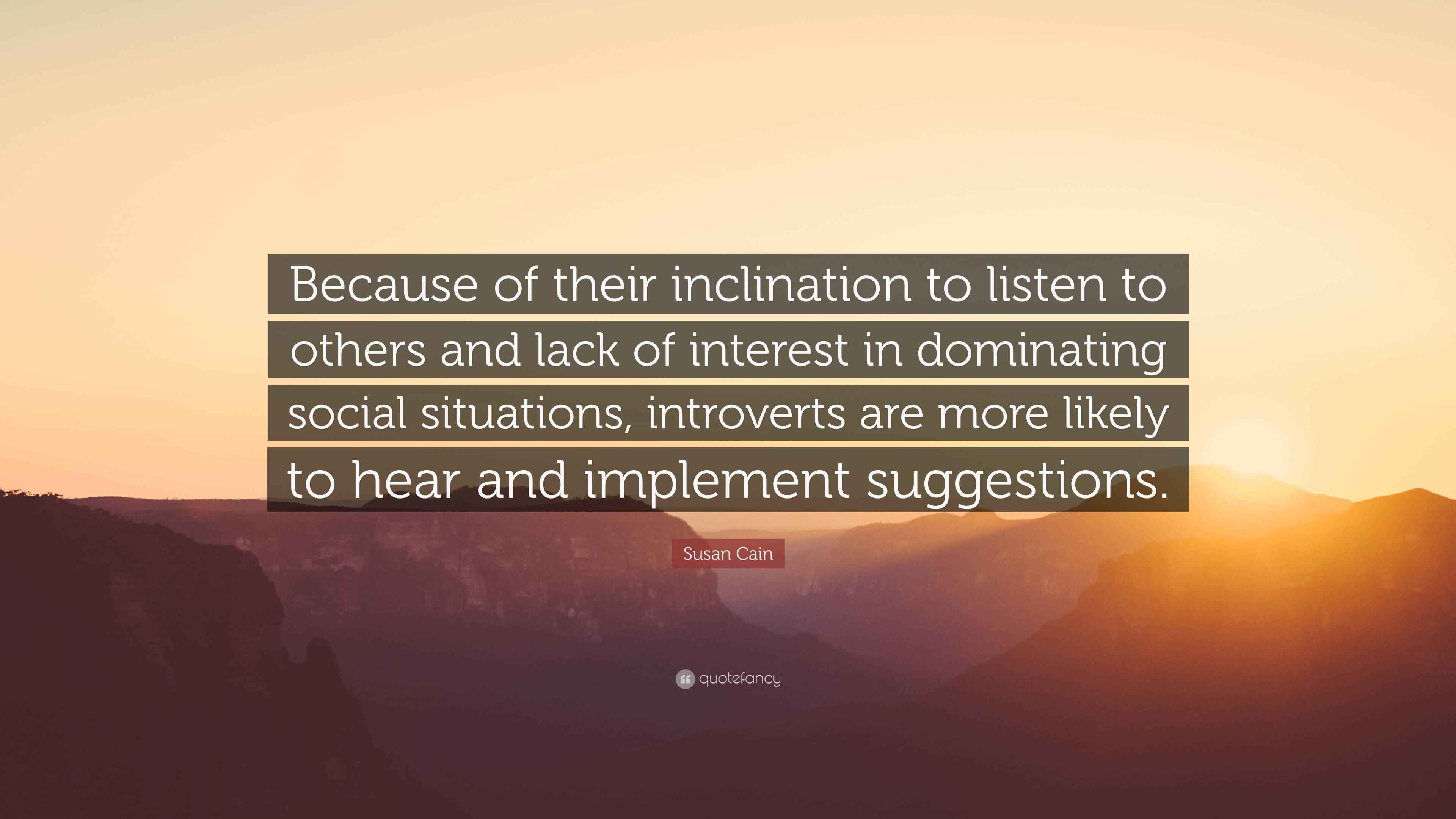
Susan Cain Quote: “Because of their inclination to listen to others and lack of interest in dominating social situations, introverts are more likely to hear and implement suggestions.”
Susan Cain Quote: “I’ve never been in a group environment in which I didn’t feel obliged to present an unnaturally rah-rah version of myself.”
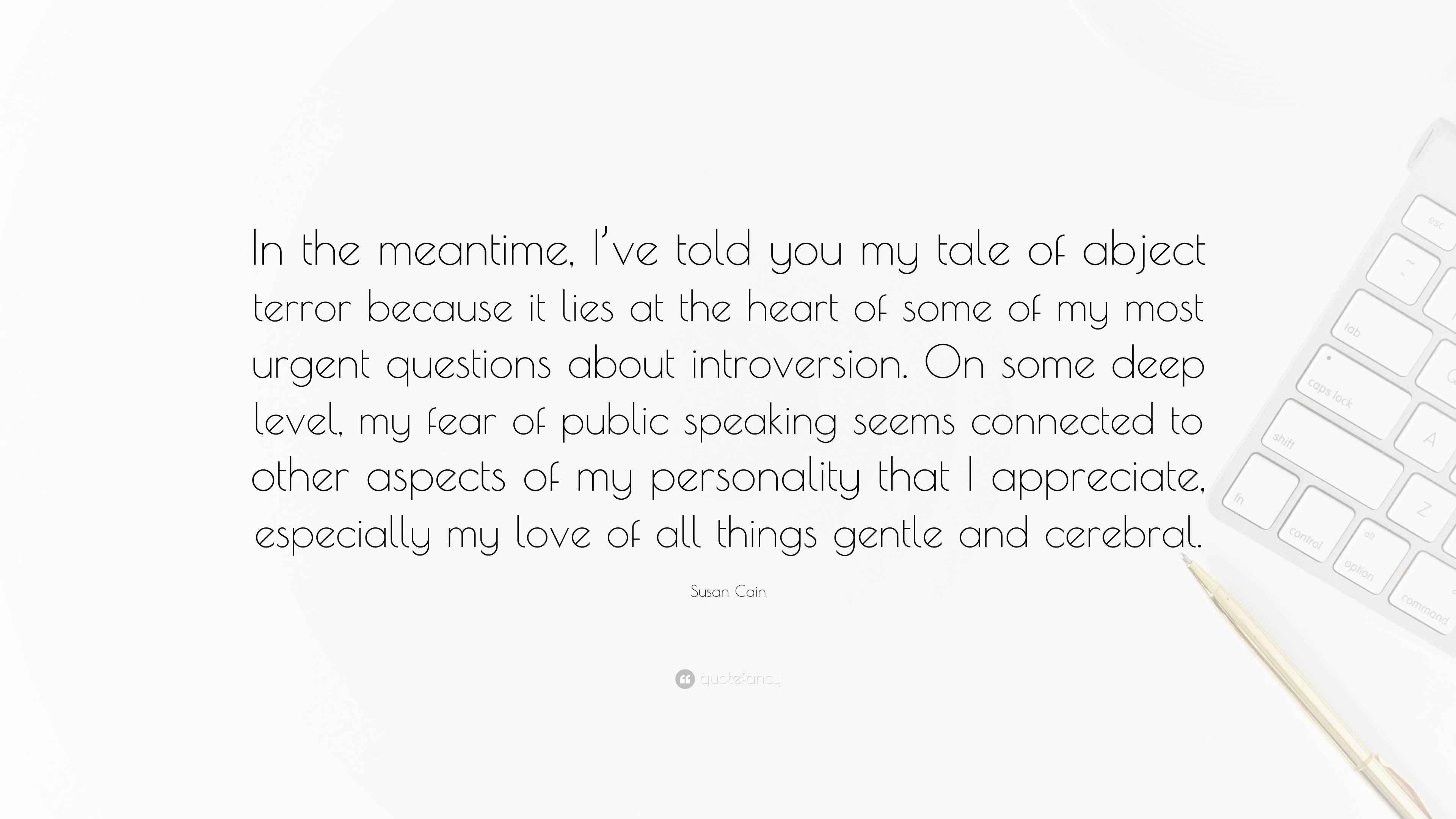
Susan Cain Quote: “In the meantime, I’ve told you my tale of abject terror because it lies at the heart of some of my most urgent questions about introversion. On some deep level, my fear of public speaking seems connected to other aspects of my personality that I appreciate, especially my love of all things gentle and cerebral.”
Susan Cain Quote: “The journalist Nicholas Lemann once interviewed a group of Asian-Americans on the subject of meritocracy for his book The Big Test. “A sentiment that emerges consistently,” he wrote, “is that meritocracy ends on graduation day, and that afterward, Asians start to fall behind because they don’t have quite the right cultural style for getting ahead: too passive, not hail-fellow-well-met enough.”
Susan Cain Quote: “There’s an unspectacular mundane suffering that pervades the workplace,” Kanov told me. “But we don’t feel allowed to acknowledge that we suffer. We endure way more than we should, and can, because we downplay what it’s actually doing to us.”
Susan Cain Quote: “In this chapter I focused on the dopamine-driven reward system and its role in delivering life’s goodies. But there’s a mirror-image brain network, often called the loss avoidance system, whose job it is to call our attention to risk. If the reward network chases shiny fruit, the loss avoidance system worries about bad apples.”
PREV 1 2 3 4 5 6 7 8 9 10 NEXT
Focus On Yourself Quotes
Psychology Quotes
Enjoy Life Quotes
Firsts Quotes
Quotes About Acting
Feeling Alone Quotes
Solitude Quotes
Country Quotes
Motivational Quotes
Inspirational Entrepreneurship Quotes
Positive Quotes
Albert Einstein Quotes

Beautiful Wallpapers and Images

We hope you enjoyed our collection of 500 Susan Cain Quotes.

All the images on this page were created with QuoteFancy Studio.

Use QuoteFancy Studio to create high-quality images for your desktop backgrounds, blog posts, presentations, social media, videos, posters, and more.

Learn more