



Create Yours

Top 500 Susan Cain Quotes (2026 Update)
Page 9 of 10

Susan Cain Quote: “The results were unambiguous. The men in twenty-three of the twenty-four groups produced more ideas when they worked on their own than when they worked as a group. They also produced ideas of equal or higher quality when working individually.”
Susan Cain Quote: “Cancel your next meeting,” he advises. “Don’t reschedule it. Erase it from memory.” He also suggests “No-Talk Thursdays,” one day a week in which employees aren’t allowed to speak to each other.”
Susan Cain Quote: “She also knows full well that “shy” is a negative word in our society. Above all, do not shame her for her shyness.”
Susan Cain Quote: “Philosophers call this the “paradox of tragedy,” and they’ve puzzled over it for centuries. Why do we sometimes welcome sorrow, when the rest of the time we’ll do anything to avoid it?”
Susan Cain Quote: “Soft power is not limited to moral exemplars like Mahatma Gandhi. Consider, for example, the much-ballyhooed excellence of Asians in fields like math and science. Professor Ni defines soft power as “quiet persistence,” and this trait lies at the heart of academic excellence as surely as it does in Gandhi’s political triumphs. Quiet persistence requires sustained attention – in effect restraining one’s reactions to external stimuli.”
Susan Cain Quote: “Introverts are drawn to the inner world of thought and feeling, said Jung, extroverts to the external life of people and activities.”
Susan Cain Quote: “The contrast is striking,” writes Michael Harris Bond, a cross-cultural psychologist who focuses on China. “The Americans emphasize sociability and prize those attributes that make for easy, cheerful association. The Chinese emphasize deeper attributes, focusing on moral virtues and achievement.” Another.”
Susan Cain Quote: “If there is only one insight you take away from this book, though, I hope it’s a newfound sense of entitlement to be yourself. I can vouch personally for the life-transforming effects of this outlook. Remember that first client I told you about, the one I called Laura in order to protect her identity? That was a story about me. I was my own first client.”
Susan Cain Quote: “In the Culture of Character, the ideal self was serious, disciplined, and honorable. What counted was not so much the impression one made in public as how one behaved in private.”
Susan Cain Quote: “Once you understand introversion and extroversion as preferences for certain levels of stimulation, you can begin consciously trying to situate yourself in environments favorable to your own personality – neither overstimulating nor understimulating, neither boring nor anxiety-making. You can organize your life in terms of what personality psychologists call “optimal levels of arousal” and what I call “sweet spots,” and by doing so feel more energetic and alive than before.”
Susan Cain Quote: “I don’t want my heart to be broken,” they say. Or, “I don’t want to fail.” “I understand,” Susan tells them. “But you have dead people’s goals. Only dead people never get stressed, never get broken hearts, never experience the disappointment that comes with failure.”
Susan Cain Quote: “Scientists now know that the brain is incapable of paying attention to two things at the same time.”
Susan Cain Quote: “If “fast” and “slow” animals had parties, writes the evolutionary biologist David Sloan Wilson, “some of the fasts would bore everyone with their loud conversation, while others would mutter into their beer that they don’t get any respect.”
Susan Cain Quote: “We know that there are physiological limits on who we are and how we act. But should we attempt to manipulate our behavior within the range available to us, or should we simply be true to ourselves? At what point does controlling our behavior become futile, or exhausting?”
Susan Cain Quote: “As adults, many of us work for organizations that insist we work in teams, in offices without walls, for supervisors who value “people skills” above all. To advance our careers, we’re expected to promote ourselves unabashedly.”
Susan Cain Quote: “Iconoclast, the neuroeconomist Gregory Berns.”
Susan Cain Quote: “We often marvel at how introverted, geeky kids “blossom” into secure and happy adults. We liken it to a metamorphosis. However, maybe it’s not the children who change but their environments. As adults, they get to select the careers, spouses, and social circles that suit them.”
Susan Cain Quote: “We tend to place compassion on the “positive” side of the ledger of human emotions, notwithstanding this decidedly bittersweet view of it as the product of shared sorrow.”
Susan Cain Quote: “That’s why Professor Little, the consummate introvert, lectures with such passion. Like a modern-day Socrates, he loves his students deeply; opening their minds and attending to their well-being are two of his core personal projects. When.”
Susan Cain Quote: “Why are some people talkative while others measure their words? Why.”
Susan Cain Quote: “It suggests that when it comes time to make group decisions, extroverts would do well to listen to introverts – especially when they see problems ahead.”
Susan Cain Quote: “Introverts just just don’t buzz as easily.”
Susan Cain Quote: “You see this all the time. People ask, ‘How did this happen, how did we pay so much?’ Usually it’s said that they were carried away by the situation, but that’s not right. Usually they’re carried away by people who are assertive and domineering. The risk with our students is that they’re very good at getting their way. But that doesn’t mean they’re going the right way.”
Susan Cain Quote: “If this is true – if solitude is an important key to creativity – then we might all want to develop a taste for it. We’d want to teach our kids to work independently.”
Susan Cain Quote: “In China there was more emphasis on listening, on asking questions rather than holding forth, on putting others’ needs first. In the United States, he feels, conversation is about how effective you are at turning your experiences into stories, whereas a Chinese person might be concerned with taking up too much of the other person’s time with inconsequential information.”
Susan Cain Quote: “The word that Kagan first used to describe high-reactive people was inhibited, and that’s exactly how I still feel at some dinner parties.”
Susan Cain Quote: “People who are aware of their sweet spots have the power to leave jobs that exhaust them and start new and satisfying businesses. They.”
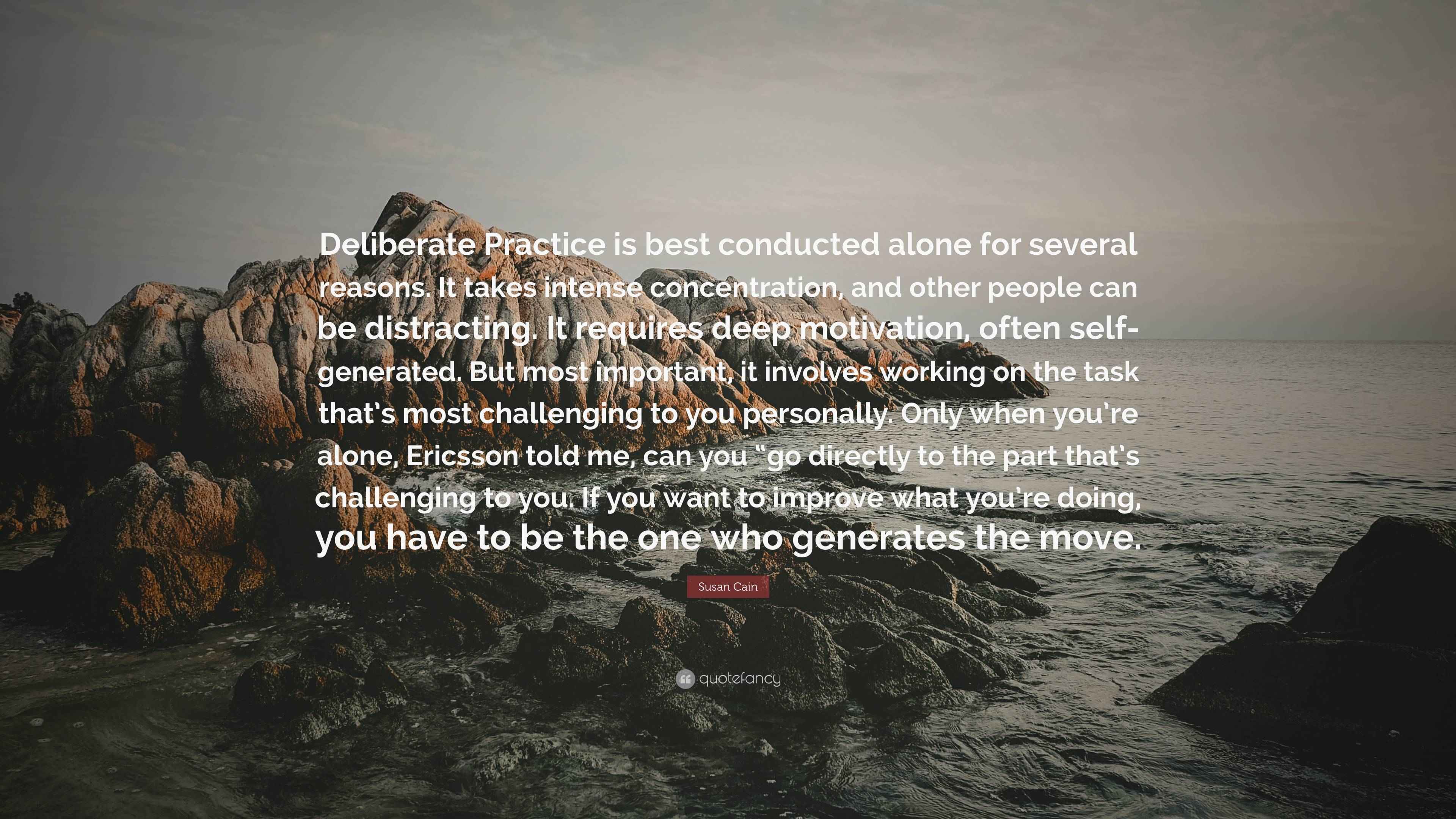
Susan Cain Quote: “What’s so magical about solitude? In many fields, it’s only when you’re alone that you can engage in deliberate practice. This is the key to exceptional achievement.”
Susan Cain Quote: “Extroverts, on the other hand, can be so intent on putting their own stamp on events that they risk losing others’ good ideas along the way and allowing workers to lapse into passivity. “Often the leaders end up doing a lot of the talking,” says Francesca Gino, “and not listening to any of the ideas that the followers are trying to provide.”
Susan Cain Quote: “Not that introverts can’t be eager and enthusiastic, but we’re not as overtly expressive as extroverts.”
Susan Cain Quote: “But what if some kids are less prone to anxiety than others, as is true of extremely low-reactive kids? Often the best way to teach these children values is to give them positive role models and to channel their fearlessness into productive activities.”
Susan Cain Quote: “It may be that some disadvantaged kids who get into trouble suffer not solely from poverty or neglect, say those who hold this view, but also from the tragedy of a bold and exuberant temperament deprived of healthy outlets.”
Susan Cain Quote: “Introverts and extroverts also direct their attention differently: if you leave them to their own devices, the introverts tend to sit around wondering about things, imagining things, recalling events from their past, and making plans for the future. The extroverts are more likely to focus on what’s happening around them. It’s as if extroverts are seeing “what is” while their introverted peers are asking “what if.” Introverts.”
Susan Cain Quote: “The high-reactive babies were not misanthropes in the making; they were simply sensitive to their environments.”
Susan Cain Quote: “In fact, a recent fMRI study shows that when people use self-talk to reassess upsetting situations, activity in their prefrontal cortex increases in an amount correlated with a decrease of activity in their amygdala.”
Susan Cain Quote: “Nor are introverts necessarily shy. Shyness is the fear of social disapproval or humiliation, while introversion is a preference for environments that are not overstimulating.”
Susan Cain Quote: “He wasn’t concerned with getting credit or even with being in charge; he simply assigned work to those who could perform it best. This meant delegating some of his most interesting, meaningful, and important tasks – work that other leaders would have kept for themselves. Why did the research not reflect the talents of people like the.”
Susan Cain Quote: “We’re built to live simultaneously in love and loss, bitter and sweet.”
Susan Cain Quote: “Since it had to happen,” King told the crowd, “I’m happy it happened to a person like Rosa Parks, for nobody can doubt the boundless outreach of her integrity. Nobody can doubt the height of her character. Mrs. Parks is unassuming, and yet there is integrity and character there.”
Susan Cain Quote: “While introverted Chinese-American twelve-year-olds felt perfectly fine about themselves – presumably because they still measured themselves according to their parents’ traditional value systems – by the time they got to be seventeen and had been more exposed to America’s Extrovert Ideal, their self-regard had taken a nosedive.”
Susan Cain Quote: “Buffett used to dread public speaking until he took a Dale Carnegie course.”
Susan Cain Quote: “What is the inner behavior of people whose most visible feature is that when you take them to a party they aren’t very pleased about it?”
Susan Cain Quote: “It was absorbing, it was exciting, and I got to meet a lot of interesting people whom I never would have known otherwise. But I was always an expatriate.”
Susan Cain Quote: “He had a courtly way of exclaiming over whatever was exclaimable in people – especially kids.”
Susan Cain Quote: “In the wake of the 2008 crash, a financial catastrophe caused in part by uncalculated risk-taking and blindness to threat, it became fashionable to speculate whether we’d have been better off with more women and fewer men – or less testosterone – on Wall Street.”
Susan Cain Quote: “Longing itself is divine,” writes the Hindu spiritual leader Sri Sri Ravi Shankar. “Longing for worldly things makes you inert. Longing for Infinity fills you with life. The skill is to bear the pain of longing and move on. True longing brings up spurts of bliss.”
Susan Cain Quote: “Try to think of happy things,” he says, caressing my forehead. I stare at the ceiling, tears welling. What happy things? Who could be happy in a world of podiums and microphones? “There are a billion people in China who don’t give a rat’s ass about your speech,” Ken offers sympathetically.”
Susan Cain Quote: “We should all look out for cobblers who might have been great generals. Which means focusing on introverted children, whose talents are too often stifled, whether at home, at school, or on the playground.”
Susan Cain Quote: “The footprint of a high- or low-reactive temperament never disappeared in adulthood. We can stretch our personalities, but only up to a point. Our inborn temperaments influence us, regardless of the lives we lead. A sizable part of who we are is ordained by our genes. We have free will and can use it to shape our personalities.”
Susan Cain Quote: “These students inhabit a world in which status, income, and self-esteem depend more than ever on the ability to meet the demands of the Culture of Personality. The pressure to entertain, to sell ourselves, and never to be visibly anxious keeps ratcheting up. The number of Americans who considered themselves shy increased from 40 percent in the 1970s to 50 percent in the 1990s, probably because we measured ourselves against ever higher standards of fearless self-presentation.”
PREV 1 2 3 4 5 6 7 8 9 10 NEXT
Focus On Yourself Quotes
Psychology Quotes
Enjoy Life Quotes
Firsts Quotes
Quotes About Acting
Feeling Alone Quotes
Solitude Quotes
Country Quotes
Motivational Quotes
Inspirational Entrepreneurship Quotes
Positive Quotes
Albert Einstein Quotes

Beautiful Wallpapers and Images

We hope you enjoyed our collection of 500 Susan Cain Quotes.

All the images on this page were created with QuoteFancy Studio.

Use QuoteFancy Studio to create high-quality images for your desktop backgrounds, blog posts, presentations, social media, videos, posters, and more.

Learn more